I've left this blog

Hello, I'm not updating this blog anymore but you can still find me over at Medium or on my website. Cheers for now.

Search This Blog

Showing posts with label digital democracy. Show all posts

Friday, 30 October 2015

87. Redesigning the council meeting: My #Notwestminster pitch

Photo credit


This post is some initial thoughts for my Notwestminster workshop pitch (by the way - you have until 23 November if you want to pitch something - first batch of tickets are available 2 November @ 11.00 details here).

I want to do something about the local democracy design challenge on social council meetings:
Council meetings discuss many issues that affect people yet they are poorly attended by the public and often pass unnoticed.  How can we get people to take part in council meetings so that they can be involved in debates that affect them?
By Council meetings I mean all of those meetings taking place in town halls that are formally open to the public.  Full council meetings, planning meetings, scrutiny meetings etc etc.  Problem is that the public just aren't that into them.

Lots of councils use webcasting and social media to encourage greater engagement which is great but doesn't quite do it.

I think Dominic Campbell captured the problem when he suggested at a Govcampcymru session that communication is not the issue - It's the product that needs to be changed.

Colin Copus has described council meetings as being theatres of representation.  This neatly captures the way in which councillors 'perform' for the public in meetings. But not that many are buying tickets.

Councils meetings do look a bit strange to the outside world.  Odd rules of procedure, hard to decipher reports and difficult to follow debates take them about as far away from a contemporary media production as you could possibly get.  I think it is safe to say that they would be as recognisable to someone living in the 1930s as to someone living now.

Of course these are meetings bound by a host of legal requirements but there must be a better way of doing things.

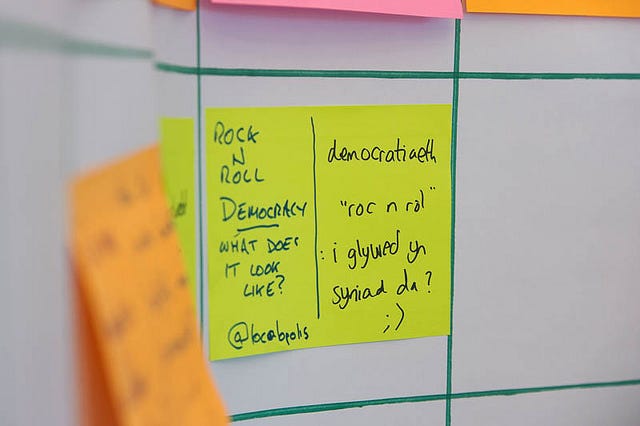
The Rock and Roll democracy session I ran at GovcampCymru came up with a few snazzy ideas including meetings like gigs, with tickets and bars and councillors like rock stars.  People can imagine something better given half a chance.

So I am thinking about a Notwestminster session that asks questions like:

  • What do citizens need from council meetings?
  • What would make people want to get involved?
  • How can meetings be (more?) exciting and entertaining?
  • What could council meetings be like? Gigs? Theatre? X Factor? Question Time?
It would be great to know what you think.

I haven't worked out how the workshop should run so let me know if you have any ideas about that as well.

UPDATE

Vote in the poll to see what metaphor we should use...

Wednesday, 7 October 2015

86. Rock and roll local democracy


Imagine that overnight a miracle happens.

Local democracy becomes like rock and roll; stripped back; simple; easy to understand; emotional; exciting; and fun.

How would you know? What would you notice in your daily life? In the morning? At work? In the evening?

These are the questions I shared with two sessions at GovCampCymru. Below is my summary of the wonderful answers I got from the GovCampers.

The questions were inspired by the miracle question; a technique used in solution focussed brief therapy. The purpose of the miracle question is to help people to understand their preferred future so that they can begin to start thinking about the small steps that might move them in that direction. After all, if you don’t know where you are going you will end up some place else.

I used this technique, albeit in a very crude way, to get some ideas from the GovCampers, thinking as citizens, about what rock and roll local democracy might look like.

The ‘local democracy should be like rock and roll’ idea comes from Lawrence Pratchett who argued that local democracy is too much like jazz — an obscure hobby for the dedicated few. It come’s from Pratchett’s chapter in the rather excellent book: British Local Government into the 21st Century. Definitely worth a read.

Someone suggested, brilliantly I thought, that local democracy is more like baroque than jazz — not only obscure but never changing and from another time. I really like this metaphor although I'm hoping it doesn't upset any baroque aficionados out there.

The two sessions were also an experiment in user research for democracy design. As I've argued before, democracy and citizens have been a Cinderella in the government design world. This was certainly not the case at GovCampCymru — maybe I was looking through democracy tinted glasses but I would say that it was the main theme of the day.

Anyhow, here is my write up of the two sessions followed by some suggestions for some small steps that might be taken towards making the miracle happen. A big thanks to everyone who took part — with any luck I have done your wonderful ideas justice. I had fun and I hope you did as well. Biggest thanks go to the two Sarahs — @SarahPrag and @WorkTheWind — who took the notes in the two sessions. Kudos guys.

The morning after the miracle

So, you wake up and local democracy is like rock and roll.

You put on your favourite democracy t-shirt. It’s got the logo of your favourite local democracy collective on the front and a list of all ten of the 2015 meetings on the back.

Check your phone and fire up twitter. Several of your friends are buzzing about a couple of meetings taking place later. One is about the homelessness policy for the area. The other is about a budget decision; the local council has money for a cycle path or a library. But not for both.

Facebook next and your friends have already set up a group to campaign for the cycle path. You are not so sure but you mull it over while you shower.

Now you head for the kitchen to get the breakfast ready.

Flick on the radio just in time to catch the ‘citizens update’ just after the weather. Yes, there are two meetings later and they both sound like they are going to be popular. You've done campaigning on the homelessness issue before but they mention on the radio that Councillor Jeremy — a major local celebrity — will be going to the cycle path meeting. You know you can’t go to both. Tough call.

The kids come down and they excited about the cycle path meeting. They heard about it at school the day before in the daily ‘junior citizens’ session. It used to be just one lesson a year on ‘how the council works’ but now it is every week, and they get to talk about the issues being discussed by the council. They like it much better. After a while the argument gets a bit overheated — as ever the oldest and youngest can never agree -one wants the cycle path, the other says the library is more important.

Outside the school you talk to some of the other parents about the meetings. Two of them run the facebook group for your street and they are pretty up on the issues through the debates that have
already taken place online.

The work day

You've got the kids to school and finally arrive at your desk. The roadside posters and billboards advertising today’s meetings had kept them in the front of your mind while you were driving.
Straight away you see emails about the two meetings from co-workers and a feature on the staff intranet about the same thing. All the usual comments and questions have been added to the intranet story. It’s just what people do while they are having their first cup of coffee and getting their minds in gear.

Next you watch the 2 minute videos on youtube promoting the two meetings— over 10,000 views for each — wow — these are hot topics!

People are talking about the issues by their desks. Your manager comes over and asks you if you are going along later. Tickets are going fast on Eventbrite for both so you might need to get your skates on she says. Meetings like this are usually popular with people queuing round the block to get in.
OK, this is the nudge you need so you get some of the last tickets for the cycle path meeting and dive into your work tasks.

As with most offices, the work day finishes at 3.00 to give people proper time to get involved in democracy meetings. Of course more people had to be employed to get the work done in shorter hours so it worked out pretty well when that change came in.

Of course democracy is not everyone’s cup of tea — it’s a bit too energetic and edgy for some — but it’s easy to tune it all out if you want to. It’s your choice.

The evening

You and the kids get to the cycle path meeting in plenty of time.

They don’t hold these meetings in the townhall any more. It’s in a community centre that has a cafĂ© bar — you get a yourself a well earned beer and lemonades for the kids.

The whole thing has been organised by the local collective and crowdfunded online. You didn't get involved in arranging this one but you have volunteered for many others. It’s been much better since all these smaller local groups and parties have started to happen. Things feel so much more relevant than when everything was organised through the old style national parties. All grassroots and DIY. Maybe more punk than rock and roll.

The main hall is packed and you find your seats and realise that, wow, you are sat next to Councillor Jeremy. Yes he has had his fair share of scandals (just check out the local papers over the last twelve months!) but you like the way he makes his points and he is your generation and you do feel you have a lot in common. A leather jacket and bright red mohawk hairstyle isn't everyone’s cup of tea but there you go.

Of course these days you can speak to any councillor, not just the one who was elected for your area. A whole range of people are councillors. Men and women of different ages, backgrounds and culture — you just pick the one you identify with most and talk to them. You picked Councillor Jeremy.

Before the meeting starts Councillor Jeremy listens carefully to you and the kids and makes notes on his tablet. He knows that he will be explaining the decision to everyone later so he is taking his time to make sure he understands what everyone thinks. It’s not long though before he’s talking to the others who have spotted him as well as signing autographs. Everyone recognises him of course and everyone feels like they know him.

Soon the debate is underway and people are making their points. There’s also plenty of questions and comments coming in via social media from those outside the hall. People are excited, the room is noisy but it’s all good natured as ever — it’s great to feel part of something. You feel proud to be involved.

Yes, local democracy is like rock and roll and you know what the best part is?

We are the band!

10 Small Steps

The purpose of the miracle question is not just to help people articulate their preferred future but to help identify small steps towards making it happen.

In the same vein, this story that came out of the two sessions, and the wonderful imagination of the GovCampers, suggests a few small steps towards rock and roll local democracy. I've listed them below (they also link pretty well to the #Notwestminster Local Democracy Design Challenges).

  1. Merchandise — t-shirts and mugs for your local democratic process. Why not? If you are proud of it let people know
  2. Advertise the issues to be discussed that day using radio, TV and social media
  3. Make and share short videos to get people interested in the issues (also check out this)
  4. Junior citizens sessions in schools that discuss live council issues
  5. Feed council topics through established local facebook groups
  6. Advertise democracy events on posters and billboards
  7. Use internal comms in councils and other organisations to encourage staff to take part in the local democratic process
  8. Hold meetings to discuss single topics of public interest held in friendly venues and ticketed through eventbrite (definitely not like council meetings). Or, even better…
  9. Support and encourage local groups to hold meetings on issues that the council is deciding on — help people to crowdsource and crowdfund these events
  10. Encourage people to get in touch with the councillors they identify with most when they have any issues — not just their local representative

Thank you GovCampCymru — hope to see you next year.

Originally posted on Medium

Photo Credit: W N Bishop 

Monday, 14 September 2015

84. The Local Democracy Publication Stream


Inspired by the recent Local Democracy Maker Day and LocalGovCamp, the suggestion here is that all council ‘democracy’ publications should be provided in a single stream (rather than by individual committee) on the Council website.  Each publication would be tagged and described by a short summary (snippet).  These snippets would provide a source of open data that could be used to build third party websites and apps to connect citizens with the local decision making process.

As Carl Whistlecraft says the Local Democracy Maker Day was something that seemed unlikely even 12 months ago.  Even though I wasn't there it got me thinking - the long distance power of the GovCamp!

It was particularly good to see the interest in one of our Local Democracy Design Challenges; making local democracy more digestible.  In particular people are asking to see local democracy publications being made more accessible via short summaries – or ‘snippets’.   These are issues we started discussing at the notwestminster event last year.

Following that Notwestminster event we have been using short summaries for all of our scrutiny reports, letters and agenda packs here at Swansea Council. These are all published via our scrutiny publications page.  We put the summaries at the top of all of our documents and in the web page that we publish them in.  Each webpage is also tagged so that the single stream list of all of our scrutiny publications can be filtered by the user.

Here are some examples of short summaries from Swansea’s Scrutiny work:
This is an agenda pack for a meeting for the Schools Performance Scrutiny Panel taking place on the 21 September 2015. The main item being discussed relates to the School Improvement Service. 
This is a letter from the Child and Family Services Scrutiny Performance Panel to The Cabinet Member for Services for Children and Young People following the meeting of the Panel on the 10 August 2015. It is about the Child and Family Services performance report. 
This is the report by the Social Care at Home Scrutiny Inquiry panel about support for older people to remain in their own homes. It contains conclusions and recommendations.
I've written about the scrutiny publications page and how it was developed here.

What if all council publications linked to the democratic process were published like this, in a single stream with all the documents tagged and each with a short summary?

Not only would it be easier for people to find things but it would provide a stream of open data that could be used for third party sites and apps.

I like the idea of a democracy dashboard, suggested at the LD Maker Day, to help people navigate the democracy data.

I'm also imagining an Amazon style ‘democracy recommendations for you’ app…

Or a facebook style democracy timeline made of things recommended by friends and councillors..

Or a ‘Medium style’ ‘top democracy stories’ reflecting my chosen tags.

It’s not quite the democracy bytes idea that we've outlined before (I still think that’s the ideal).  But it would be a great step in that direction.

Anyone want to build it?

Photo: https://flic.kr/p/q9h3YZ

Tuesday, 26 May 2015

82. Design Challenges for Local Democracy - Take 2


Along with some of the #Notwestminster gang, in particular @72prufrocks and @gr8governance, I've been developing a set of design challenges for local democracy.  At this stage we just want to capture a high level list that can be used as the starting point for some serious redesigning.

The raw material came from the Notwestminster event and some of the work we've done previously around local digital democracy.

The first version of the list was shared on twitter and sparked some lively debate - this second version is our attempt to respond to some of that.

All comments very welcome.

Design Challenges for Local Democracy

  1. Connected Candidates: High turnouts in local elections are a mark of a healthy democracy and yet many people have no motivation to participate.  How can we get people connected to their candidates so that they will see a reason to vote?  
  2. Real Representation: The job of the local councillor is to represent their constituents yet their wards can include as many as 25,000 people, all different, all special.  How can councillors better reach out to people in their community so that everyone can be properly represented?
  3. Social Council Meetings: Council meetings discuss many issues that affect people yet they are poorly attended by the public and often pass unnoticed.  How can we get people to take part in council meetings so that they can be involved in debates that affect them?
  4. Social Decision Making: Councils make many important decisions yet the people who are affected rarely have their say.  How can we get people involved in local policy making so that they  can influence the decisions that affect them?
  5. Community Campaigns: In a healthy democracy change comes from the bottom as well as the top and yet it is nearly always the politicians that set the agenda.  How can we get people to talk more to each other about the issues that concern them so they can build campaigns and change things? 
  6. Community News: The more people talking about their local democracy the better and yet local councils are not always best placed to tell people about what's happening.  How can we help journalists and bloggers to know about local political stories so that they can share them with their readers?  
  7. Democracy Alerts: People don't spend their time studying council agendas and forward plans so it's no surprise that they don't know when decisions are being made that affect them.  How can we ensure that people know about decisions that affect them so that they can get involved if they wish? 
  8. Open Democracy Data: The details of local council decision making affect everyone's lives and yet they are often obscured within agendas, minutes and reports.  How can we better share the data of local democracy so that it is open to be seen, used and shared? 
  9. Young People: The young people of today are the voters of tomorrow and yet many see local politics as irrelevant.  How can we get young people involved in local democracy so they have a voice, both now and in the future?
  10. Inclusive Democracy: Everyone has the right to participate in local democracy and yet many have barriers placed in their way whether because of poor health, impairment or disability.  How can we ensure that all local democratic activities provide a fair chance for everyone to participate?
  11. Democracy Clubs: If local democracy is to be more than what happens in the town hall then a wider range of interested citizens need to be involved in keeping it up to date.  How can we help democracy enthusiasts to work together so they can help each other, switched on councillors and councils to redesign local democracy?
  12. Uncontested Elections: Healthy debate during elections is a cornerstone of democracy and yet too many local elections are either uncontested or one sided in the minds of the voters.  How can we encourage more people to stand so that that everyone gets to be part of a lively and contested local election?
  13. Voter Information: If democracy is to work then voters need to be properly informed about their candidates and yet much of what they receive is biased and sometimes even inaccurate.  How can we ensure that voters in local elections get the facts and figures that they need to make an informed choice?
Update:  Lots of suggestions for new challenges so here are an additional five - absolutely free!


  • Digestible Democracy:  Local democracy needs to involve the widest range of people and yet the format of reports and the use of jargon puts off all but the most dedicated.  How can we present local decision making so it's less obscure like modern jazz, and more popular, like rock and roll?
  • Understanding How It Works:  Local government represents communities and makes decisions on their behalf and yet very few people know how it works.  How can we make local government understandable for ordinary people so that they have a better chance to influence? 
  • Agenda Setting:  It's important that local policy makers focus on the right issues and yet it the public often has little say in what is chosen.  How can the public be involved in setting policy topics so that they can see why chosen topics are important?
  • Access to Voting:  The importance of a high turnout at local elections is widely recognised and yet the practical process of voting can sometimes be difficult.  How can we ensure that voting in local elections is simple so that everyone can easily have their say?
  • Candidate Diversity:  Local councillors represent the whole community and yet they are overwhelmingly male, white and middle aged.  How can we encourage a greater diversity of candidates so that councillors reflect the whole community?  


Photo: https://flic.kr/p/qNWdKF

Tuesday, 10 February 2015

77. #notwestminster

Carl Haggerty had it right when he blogged yesterday:
Remember this date : Saturday 7th February 2015, because on Saturday in Huddersfield a special event We’re not in Westminster – Local Democracy for Everyone took place that created the space, time, inspiration and curation to bring together an amazing group of people to discuss and suggest small and big changes to how local democracy works.
It certainly felt to me like a game changer.  We talked about practical stuff, yes, but there was also energising, re-energising and inspiring by the bucket full.

This post isn't about the event, excellent though it was (I've already blogged about my workshop and others are blogging as well - here is the Storify).

This post isn't even about all the brilliant people who came together to make it happen (although they are and they did).

It’s about the #notwestminster hashtag – or, perhaps more accurately, it's about the attitude.

When Carl (@gr8governance), the impresario of the event, told me Diane’s (@72prufrocks) idea for a strap-line, I knew straight away it was perfect.

"We're not in Westminster anymore."

Most people know 'We're not in Kansas anymore' is quote from the film The Wizard of Oz.

It gets used as a saying that means, according to the Urban Dictionary:

When you're in a place or situation that is outside your comfort zone or scope of understanding. Strange surroundings.

By swapping Kansas for Westminster it gives you the sense that local democracy is very different to national government - that it's a very different world.  This post about a recent GovCamp by @emilyaturner illustrates that point very well.

It's also a reminder that democracy happens outside of what is, after all, a very small part of the capital city. As John Popham has reflected, the fact that the #notwestminster event took place in Huddersfield is refreshing to say the least.

My hope is that the #notwestminster hashtag continues to be used.  For me it represents:

  • the uniqueness of local democracy
  • the fact you need to live it to understand it
  • the passion that many of us have for all the good stuff 
  • the excitement that there is around change for the better 

Remember, if we are not in Westminster anymore then maybe we are somewhere over the ....

Photo credit: https://flic.kr/p/ot1uRA

Sunday, 8 February 2015

76. Three user stories for local democracy

This is my write up of the workshop I ran at the #notwestminster event.  Here is a lovely storify by John Popham if you want to find out what it was all about.  It was quite excellent by the way.

The workshop looked at how the user story technique might help us to redesign democracy around what people need.  User stories are simple statements always written in the same way:

As a... I need to... So I can... 

You can see the set up for the workshop plus some background links over at the event website here.

Our mission, as with all the other workshops, was to come up with three ideas for local democracy that people could take forward and work on.

Three user stories


The three actions from this workshop came as three user stories (I've simplified a little):

1.  As a local resident I need to see council reports in a form I can easily digest so I can understand the decisions that are being made

2.  As a disengaged voter I need to understand why politics should be of interest to me so I can work out whether to vote and who to vote for

3.  As a council policy officer I need to see through the eyes of the public so I can deliver good solutions to the actual problems people face

The process


It's worth saying a little about the process just because the workshop went a little differently to any I've run before - I have been trying to learn a little from the principles of service design and apply those.

  • I brought a lot of cards with me and put some instructions on the back
  • These were then handed out to people at the event who were asked to write their user stories and post them in the ballot box (provided by @72prufrocks - thanks!)
  • By the time we came to the workshop we had collected about 40 cards which turned out be just right for the time we had
  • For the workshop we stood up in a group and, discussing each card in turn, sorted them and stuck them on the wall under one of four headings; 'mmm, not sure what that means'; 'yes, this need is already met'; 'woah, that will need a big change'; and 'yes, definitely one to think about'.
  • We then sorted the ones we had in the last pile between; 'small difference'; 'some difference'; and 'big difference' piles and we were left with 6 cards which we discussed and reduced to three.
  • This all took about 40 minutes.

I think it worked pretty well and group were happy with the final choices - well done guys!

What next?


Well our challenge is to work on these stories and come up with solutions.  At the end of the event everyone had a chance to sign up to working on things they wanted to change so think of this post as just a first step - watch this space and let me know if you want to get involved.

More stories


Here are some other user stories from the event to give you a flavour of the discussions:

As a person living with a loved one in a care home I need to understand the democratic accountability for his care so I can decide how to vote in a way that will make a difference and know who to hold to account when things go wrong
As a resident I need to be more aware of what my local council are doing so I can have more say in how I live in my home
As a student I need to be more aware of what is happening in local government so I can solidify my future
As a regular traveller I need to find ways to connect with the work of the council so I can volunteer and contribute when I have time available
As a fun loving individual I need to feel that I can be myself in meetings, when writing letters etc... so I can express myself freely
As a youth council coordinator I need to reach more young people so I can empower them!
As a broadcast journalist I need to raise awareness of the local council so I can get people more involved in politics


Friday, 14 November 2014

75. Stand Alone Local Democracy Websites

No council websites were harmed in the making of this post.

The idea here is to have separate websites for local democracy.  At the moment council democracy stuff is incorporated into websites that are mainly designed to support and promote services.  Creating separate sites would bring all the democracy stuff – committee information, councillor details, scrutiny and elections out of the shadows of all that service stuff and into the light!

Parliament has its own separate ‘democracy site’.  So does the National Assembly for Wales.  So why not local government?

Democracy stuff can usually be found in a corner of the council website under ‘Council’ or ‘Your Council’.  Website design rests heavily on ‘top tasks’ and responding to customer needs – it’s job vacancies, rubbish collection details and school term dates that get prominence because those are the things that people look for.

Democracy matters – it needs greater visibility.

Another problem is that the way we interact as customers of services is different to how we might interact as citizens with a local democratic process.  A local democracy site needs to tell me about the things I’m entitled to know – not just the things I know that I want or the things the council wants me to consume.

My argument is that local democracy presents a distinct design challenge – one that can only be properly addressed away from the frameworks of local government ‘service’ websites.  Having separate sites should open up a market for design and, who knows, even lead to open source solutions that everyone can use.

In areas where there are multi tier councils you should only need one site for the local districts and county councils.  Less need for mergers perhaps?

And these local democracy websites need not just be about local government – they could provide a space for citizen bloggers and hyperlocals - and a focus for annual democracy plans.  They could provide a single focus for a range of accountability mechanisms (health, Police and Crime commissioners etc etc).

As a 'user' of democracy I'd like to have everything in one place.  Wouldn't you.

Saturday, 11 October 2014

73. The Double Doughnut of Democracy

The double doughnut of democracy is the idea that government should not engage directly with the public.  Instead public engagement happens through a ring of sharers such as councillors, community groups or the media.  While potentially more effective, this approach implies that government has to work in a different way. 
mmmmm doughnuts
This idea draws on three sources.

The first is a conversation we had about online democracy at govcampcymru. 

The second is a set of ideas developed by Catherine Howe that I heard about first at localgovcamp.  While Catherine is more interested in a citizen perspective here the implications for government are centre stage.

The third source is some conclusions form the academic literature.  Lawrence Pratchett in a paper for Parliamentary Affairs suggested that intermediate bodies such as the media and community groups might be the best route for public participation as local government is essentially a representative rather than participative institution.  Similarly, Marion Barnes, Janet Newman and Helen Sullivan in their research into public participation, suggested that participation initiatives might be more successful when semi autonomous from government and run by voluntary groups. 

The double doughnut of democracy is essentially a public engagement strategy for local government (or any government for that matter).

It is underpinned by the assumption that local government has neither the capacity or the capability to involve the public in the democratic process; it's just not very good at this kind of thing. Explaining why public participation is such a big challenge for local government is a big topic  - more here if you are interested.


Instead local government should work with the sharers - the people who can take the stuff of democracy, engage with the public and report it back into the process. 


The sharers (Catherine Howe calls them the civic creators), who are the middle ring of the double doughnut, include:
  • Councillors
  • Council officers
  • Partner agencies
  • Voluntary and community groups
  • Citizen bloggers
  • Journalists

Adopting the double doughnut means a number of things:

  • Talking to the sharers about their needs and how you can meet them - they are the 'service users' for online democracy
  • Publishing the stuff of democracy in a form that can be easily shared, online and off
  • Taking steps to build the 'democracy community' - recognising and supporting the sharers
  • Responding to the feedback 

This last point is of course a massive practical and cultural challenge - recognising that it needs to happen would be a good start.

Sunday, 28 September 2014

72. Online democracy: Seven questions for government


An unconversation at GovCampCymru


This is my write up of the online democracy session at GovCampCymru (and some other linked conversations).  GovCampCymru was in fact a thoroughly excellent day organised by Satori Lab and friends.  What? You couldn’t make it?  Then come to the next one.

This particular session was about online democracy, in other words the minutes, agendas, reports etc etc that local, devolved and national government make available through their websites.  The idea was simply to start a conversation about how this stuff could be improved, who uses it, what they want and so on.  What I really liked was the opportunity to bring a mix of voices to the discussion; policy types, democracy types, technical types, community types etc.  Thank you so much for all the contributions on the day or otherwise. This is very much my take so please, if  I've got it wrong or missed anything - just add a comment.  Also – sorry if this a bit long.  I didn’t have time to make it shorter.

At the heart of our discussion were the following seven questions for government about their online democracy:

1. Is it readable?


Seems pretty basic but actually this stuff is hard.  The language of decision making is not the language that people use in the pub. Perhaps the process itself needs a more technical language but, when governments share, they need to make sure people know what they are saying.  We talked about the way that the Government Digital Service approach language and thought this was worth using.

2. Are you clear about the purpose? 


Have you thought about why you publish this stuff online?  For information? To ask for people’s views?  To ensure politicians are held to account?  Just because you have to?  Once this is clear you can design what you provide.  You can also tell people why you are providing it so they know what to expect.

3. Do you know what the users want?


‘Users’ here means the people who actually look at all of those online minutes, agendas and reports.  Do you know who they are and what their needs are?  Do you know how they come to your websites and what happens when they do?  In service design this is sometimes called mapping user journeys – putting the citizen at the centre of what you provide. As someone in the group put it: 'If we want people to get involved, we need to open up and work from bottom up. Need to ask people'

I did some initial twitter ‘research’ on who uses this stuff at local government level and why.  Here are a few of the suggestions:

  • Councillors to support their role and find out what is happening in their community
  • Council officers to help them do their jobs and to know what decisions have been made
  • Active Citizens / Citizen bloggers to hold politicians to account and to make sure people know how the democratic process is affecting their area
  • Charities and communities groups looking for anything that affects the people they work with and to support ‘lobbying’ of councillors if they need to
  • Journalists to find information about planning applications but also any policy related news stories
  • Local campaigners who want to know what is happening about their issue
  • People who just want to find out what is happening in their area
  • Students because they have to for their assignments
  • Auditors so they can check if the council is being run properly

It was great to hear that the Welsh Assembly have been talking to citizen bloggers about their needs – I’d love to learn more.

4. How will your content get to the non users?


Most people, of course, have nothing to do with online democracy and may never want to.  But the stuff going through the democratic process affects them so how are you going to reach them?  Have you thought about the mediators (many listed in the point above), the ‘civic sharers’ who can pass this stuff on?  Government is not very good at working with the ‘hard to reach’ (terrible phrase, I know) but other bodies are.  How are you going to make use of them?

5. Is you content shareable?


The advantage of social media is that it is easy to share.  But online democracy is not particularly shareable.  Content captured in lengthy pdfs is hardly likely to go viral.
We talked about the short form / long form approach that many use in central government.  If every meeting item, every report was captured and published as a shareable summary it would be much more likely to get people engaged.  I also like the point that was made about making digital democracy digestible ‘like john Craven's Newsround’:)

6. How will you make your content relevant?


People want to know about the stuff that affects them yet government publishes only in a way that suits the process.  People in the group pointed out that:

  • The content of politics is generally vague and/or boring 
  • People shouldn't have to consume the whole damn process 
  • Our democratic content is nothing then everything i.e. There is no warm up
  • We need to work on how to get to the right people - digital democracy is not necessarily about getting lots of hits or likes 

There are lots of new platforms springing up (like vocaleyes) that might make the process more relevant and meaningful and relevant for people – how are you going to link with these?

7. How will you respond?


Finally, and perhaps the most difficult point is what are you going to do as a result of engagement?  If online democracy is just about informing then be honest and say so.  But if you tell people that you want to engage - then what does this mean?

The view in the group was that the culture of government is not a responsive one:

  • The importance of having a responsive back end to go with any fancy front end for digital democracy
  • We need to create organisations / democratic structures that care about what people say in consultations because generally they don’t
  • There is a difference between disseminating information and starting a conversation

What can we do?


At the end of the session we identified two prices of work that would thought would really help:

  • A style guide for online democracy to help ensure it is readable and shareable
  • Research into what users want from online democracy – some user journey maps that government can learn from 

Ok, let’s get started then...


Monday, 23 June 2014

67. 11 digital tips for new councillors

These tips come from our @LDBytes session at #localgovcamp June 2014 co facilitated by @gr8governance who also helped with the editing - cheers Carl.  It's part of our Rewiring Local Democracy work.

Good points being made
It was a brilliant day and we were fortunate to have a great mix of excellent contributors; councillors and officers; in the room and via twitter.  This list is a just a starting point – please feel free to add and correct.

Our question for the session was ‘What advice would you give to new councillors who want to use digital?’  This was not particularly about councillors who had never used twitter before (although it works for them as well) but for those who perhaps already know social media but want to find out how to use it in their new role.

The consensus was that digital does make better councillors but you have to know why you are using it; that it’s not just about broadcasting messages – you need to engage and respond.  We also thought that digital should be part of every councillor induction but, just in case it isn't where you are; here are some tips to get you started.

1.     Find out your local rules.  We certainly got the feeling that social media for councillors is on the rise but not yet everywhere.  Some councils still ban twitter from meetings for example whereas others encourage all their councillors to go digital (Lambeth sounds like a great example).  If you don’t like what is going on with you then you should...

2. Change your local rules.  Ask the people who run your council why things can’t be different, hang on a minute, you run the council don’t you?  Not sure what you are asking for?  Here is a handy checklist to get you started.

3. Check out what support is available.  Again, there can be big differences between councils, and between different councillor roles (Cabinet and scrutiny for example) but see what is available.  Make sure that officers are producing the kind of content that you will want to share through social media.

4. Listen before you speak.  Social media is a listening tool first and foremost.  Also it is important to get to know the terrain before you contribute.  We also heard some very good advice about pausing before you respond – you are publishing in public after all.

5. Don’t annoy people by campaigning.  Even at election time.   People want to hear about what you are doing to improve the area but will get turned off by constant recycling of ‘party lines' on social media.

6. Be careful when tweeting from meetings.  Not everyone thinks this is a good idea or likes to see councillors tweeting when they “should be listening”.  You should play this by ear (see point 1).   One thought we had was that an official twitter feed from meetings provided by officers would reduce the need for councillors to tweet (see point 2).  The officer stream is good for providing the commentary (which is by its nature factual) while the councillor value is in providing personal insight and views. In an ideal world we would like to see free wifi provided in council chambers and everyone encouraged to use social media (see point 2, again)

7. Use twitter.  As an organising tool – you can link to campaigns using hashtags and even start campaigns.  As an accountability tool – let people know what you are doing and maybe even, how you are voting.  As a way to link to useful people in your area.  Often councillors are given lists of other councillors to follow but what about the local CVS, partners, private providers, the hyperlocal websites, the movers and shakers etc etc.  We think every councillor should be provided with a ‘who to follow list’.

8. Find the councillors who are already using digital and speak to them.  Councillors learn best when they are hearing it from other councillors so find out who does it well in your area or the next area or wherever.  We think Council’s should involve social media savvy councillors in delivering their induction training.  It has worked in Kirklees – check out cllrsocmed to see what we are talking about.

9. Make sure you know what to do during an emergency.  We heard examples of how councillors both helped and hindered by using social media during emergencies such as floods.  Make sure you have the right advice before giving it to others.
Update:  Ben Proctor said he would write something on this.  And he has.  And it's a must read.  Read it here.

10. Don’t forget the non- digital folk.  You need to use the right channels to reach the right people but actually you, as a councillor, are brilliantly placed to do this.  We heard about how church halls can be used alongside facebook pages to reach out wider.  You are in the perfect position to connect everyone together.

11. Promote digital democracy.  As a digital councillor you should be a champion for the ways in which digital can get people involved.  We talked about online registration as one very good example – but we all need to be on a mission to get people involved and voting.  Always.

Photo: @surajkika

Thursday, 5 December 2013

62. Seven tips for writing your digital democratic content


Working in a democratic rather than a service context means that you have to write your digital content a little differently.  As a scrutiny team we have been thinking about how we can produce content on our website that councillors will want to share and engage the public with.  Here are the seven points we have come up with - some apply to all digital content, some have a democratic twist.

1.  Focus on a single point of public interest


Each post should be about one thing so that it translates easily through social media.  You can add detail at the end but don’t muddy the waters by having more that one up-front aim.

The point of public interest is something I've written about before. Successful content will be about something that people actually care about.  Think carefully about which 'public' and direct the post to them.  Is your post for all residents, for social workers, for parents, for carers?  What will motivate them to share, read or engage? What do you hope to achieve?

2.  Carefully craft the title


Turns out that most people will not read beyond the title of any content but that doesn’t mean that they won’t share it.  Using ‘you’ or the name of a group (e.g. parents, teachers) works well.   So do lists such as ‘ten ways to…’  Oh and adverbs and verbs work much better than adjectives and nouns.  A well crafted title will help with sharing through twitter and facebook.

3.  Summarise with a neat and tidy snippet


If people get beyond the title then they may not get beyond the first paragraph – what we call the snippet.  It needs to be short and it needs to deliver the main point of the post.  Have a look at these eyetracking heat maps to see why this matters so much.  This snippet might also be what people see when they come across your post through a google search.

4.  Use an engaging style


We can’t write for digital the same way as we write reports and council minutes.  The style has to be punchy, friendly and engaging.  We like the suggestions in this great post about digital style.  Check out the localgovdigital standards for other really useful tips on writing content.

Update:  Some extra things to consider from the world of press releases on making your content more engaging if you are stuck.  You don't have to do all of them!

  • Highlight what is different as a result of whatever it is you are talking about
  • Why is it relevant and why does it matter?
  • What are the risks / consequences of not doing something?
  • What is the human interest? How will it affect 'real' people
  • Are there striking facts and figures that you can include? They must be relevant of course!
  • Can you include a quote from someone involved?

5.  Include a picture that tells the story


A great image can add a lot to your post but a stock corporate photo can make it seem, well, a bit lame.  If you want to get your post shared on facebook then carefully consider the image. You might be able to find something good on flickr (under a creative commons license of course – and properly credited) but if you can provide your own picture of the actual thing that happened then even better.

6.  Place the content where it will be seen


If you want councillors to share content then you have to put it where they will see it.  A little time searching on google will tell you where your councillors are – we found that about half of our scrutiny councillors had social media accounts with facebook, LinkedIn and twitter being the most popular.

7.  Do the promotional work


To give your post the best chance of being shared you should probably also do a little nudging.  Facebook and twitter give you the option to target individual councillors and simply asking people to share or retweet can also make a difference.  Use email to encourage sharing and hey, if you are meeting with councillors in person why not just ask people face to face.


We have produced this checklist as part of our scrutiny bytes project - part of the rewiring local democracy strand of localgovdigital.  

Photo credit:  http://www.flickr.com/photos/sdasmarchives/5019111466/

Tuesday, 3 December 2013

61. Find the point of public interest

One the questions raised by our Scrutiny Bytes project is 'what type of digital content will the public want to share, read and respond to?'   This matters because this is exactly the content that councillors are going to want to pass on to the public.  Of course this is something that goes wider than digital content and is an important issue for public engagement more generally.  Here are some first thoughts.


The point of public interest, as illustrated by this rather impressive felt tip Venn diagram (does it make you nostalgic for OHP presentations?), is the overlap between what the council (or other government body) is doing and what the public are actually interested in.  The former is easy to work out but the latter less so.

Democratic content is different from the content produced to support service delivery.  If you are producing content for the public as customers, for your council website say, you have a lot more to work on.  You see what people are searching for and design your ‘top tasks’ to reflect this.

For democratic content, however, you are producing content for the public as citizens.  You are working on the basis of what people are entitled to know even if they are not already aware of it.  You are pushing content out from the democratic process rather than responding to customer demand.

Having had a look at some of the wisdom around the web on why people share online content, and having had some initial conversations as part of the Scrutiny Bytes project, I think that there are three questions you have to answer if you want to find this point of public interest:

1. Who is it for?


Public is much too broad a term to use of course.  You need to design and target content at a specific group or groups.  This could mean residents in a particular area, parents, young people, teachers, social workers, you get the idea...  Answering this question is important because it sets you up nicely for the next one.

2. What is the motivation?


'What the public cares about' can be broken down into a number of sub issues.  One good way to get some insight here is to put on your own citizen's hat.  We are all citizens of course so think about what would motivate you to share, read or respond.  Four suggestions here:

  • It will directly affect you.  By which I mean a service is closing, a new facility is proposed for your area or a benefit is being changed.    
  • It will help you.  Useful knowledge such as a better way for you help your child with their reading, an easier way to get your residents parking permit or advice on home energy efficiency.     
  • It matters in your world.  Something that is newsworthy in your circle for example your neighbour's road safety campaign, a food inspection report on the local takeaway or recognition for your chess club's schools project.
  • You get a reward.  This could be a 'money off' deal or entry into a prize draw.  It might be recognition as in 'we will post the three best suggestions on our website'.  It might also be something useful to download or keep. 
This motivation is the hook that will make your content leap out from someone's timeline.  There is a lot of competition for people's attention so you need to get this right.

3. What will it achieve?


Finally you need to be clear about what you hope to achieve from people sharing, reading or responding.  Is it simply raised awareness you want or perhaps you are looking for feedback?  Either way your aims will limit or extend the amount of room you have to work in when looking at the Venn diagram, above.

Finding the point of public interest, the overlap between what the public care about and what the organisation hopes to achieve is not going to be easy.  But, if we want digital democracy to be a two way conversation, getting it right matters.

Sunday, 1 December 2013

60. Scrutiny Bytes

Public engagement will be an increasingly important aspect of the local government scrutiny function.  Digital tools and behaviours provide a brilliant opportunity to enhance this engagement.  It sounds like a marriage made in heaven but exactly how can it work? Scrutiny Bytes is a project we are running in my council that tries to answer that question.

I've written before about the idea of democracy bytes.  Just as a byte is a unit of digital information so a democracy byte is a unit of digital democracy.  Bytes are the simple statements that together make up democratic conversations.  They might be questions, opinions, proposals, decisions or outcomes.

Scrutiny Bytes is a project about applying this idea to the scrutiny process.  Conversations typically will be held around; the performance of a service; work on policy or strategy development; the holding to account of Cabinet Members or other decision makers; or the planning that is done for the scrutiny work process.  Conversations might centre on a single meeting but more likely on a longer process such as an in depth review or inquiry.


You can see the central idea in the diagram above.  It works in five stages:

  1. The scrutiny team convert what comes out of the formal scrutiny process into bytes through the Swansea Scrutiny website.  The key here is to produce content that people will want to share.  We are not expecting people to want to come to our site necessarily – content needs to go to the online places where people already are.  
  2. The content is then placed where councillors can share it.  In Swansea about a third of our scrutiny councillors are active on social media in some way.  The most popular platform is facebook followed by linkedin and twitter.  It is important to underline here that the emphasis is on councillors (not officers) sharing – this is a democratic process after all.
  3. The idea is that content will spark conversations between councillors and the public in which ever place it is shared.  While sharing and engaging is a fundamental part of what councillors do - doing it online is different and these new behaviours will need to be carefully worked through.
  4. The results of these conversations will be harvested by the scrutiny team and summarised into reports that can be fed back into the formal scrutiny process.  As with any research method careful thought will need to be given to how this is done.  Reports will also provide a means of feeding back to the public what councillors have heard.
  5. These reports can then be presented to scrutiny meetings, working groups etc. where they can influence the work that scrutiny councillors do in their more traditional and formal setting.  Of course new questions will be raised so the process can start again.

The purpose of this post has been to provide a brief outline of the thinking behind the Scrutiny Bytes project.  It’s early days but I will feedback as we make progress through the different stages.  Specifically I hope to share the outcomes of the work that we are doing:


Friday, 17 May 2013

55. Democracy Bytes


Just as a byte is a unit of digital information so a democracy byte is a unit of digital democracy.

If we want to make traditional representative democracy more open, engaging and vibrant by digitising it (and we do) then we need to be clear, conceptually speaking, about what the stuff of democracy actually is. Democracy bytes are that stuff – democracy, broken down into its constituent atoms, so that it can be digitised and shared.

The argument here, which is about how we use digital to enhance local democracy, comes in four parts:
  • We should be talking about the local decision making process rather than meetings, organisations or even elected representatives although they are all relevant and important of course.
  • The local decision making process can be broken down into many separate democratic conversations that lead to decisions.
  • Democratic conversations can themselves be broken down into four basic and distinct types of democratic statement; questions, opinions, proposals and decisions.
  • Democratic statements can be digitised and shared with citizens as democracy bytes.
This post is a development of the ideas I’ve previously shared on Social Council Decision Making and is an aspect of the wider Digital Democracy Framework developed with Carl Whistlecraft. Carl and myself are part of the Localgov Digital Steering Group, where we are majoring on ‘redesigning local democracy in digital world’ and this is a part of our contribution to that work.


Democratic Conversations

If we want the public to be engaged in the local decision making process then we need to offer people simple routes into the decision making conversations that interest them. One big problem with the process at the moment is that local politics is, without an investment of time and effort, a mystery to most people. Lawrence Pratchett uses the metaphor of jazz to argue this point:   
The argument here is that the institutions of local politics have become like jazz: without a high level of concentration they are incomprehensible to most people.... This is not an argument that says that most people are stupid and that politics needs to be ‘dumbed down’. Rather, it is an argument that most people are too busy doing other things to worry about the institutions of local politics: they do not want to work that hard to understand something that is often deemed peripheral to their lives (1).
As Pratchett notes, Jazz was effectively superseded by rock and roll, a form of music that ’stripped back this sophistication to a much simpler sound that was easier to follow and understand’. Not that Pratchett is arguing for simplification at the expense of the necessary subtleties of a political system but rather that the answer might lie with intermediary bodies such as the media or voluntary groups who might act as interpreters.

Democratic Statements

To define a democratic conversation we have to break it down into its constituent parts. In short we can say that a democratic conversation starts with a question, ends with a decision and includes opinions and proposals. Questions, decisions, opinions and proposals are all basic types of democratic statement where:  
  • Questions are the start point of conversations. They are a statement of a problem and an invitation to an audience to participate (they may not always have a question mark). They can originate from anywhere but must be adopted by a decision making individual or group. Examples would include scrutiny topics, consultations or planning applications.
  • Opinions are statements that set out the view of a particular person or body in respect of a question. They will normally be supported by evidence or at least clearly stated reasons. Opinions belong to a named individual or group (e.g. Citizen, Cabinet Member, Council, Scrutiny Committee). They can be presented anonymously as part of a conversation but somewhere it must be known that they are owned by someone entitled to present them. ‘Facts’ enter the process as opinions, partly as every ‘fact’ has some element of subjectivity but more because the relative importance of a ‘fact’ for a question certainly is down to opinion.
  • Proposals are statements that make a recommendation about what an individual or group, responsible for a decision should do. They are directed to the specific individual or group who has the power to make the decision. Proposals are promoted by questions in as far as closed questions limit the range of possible proposals down to a minimum of two whereas open questions are less prescriptive.
  • Decisions define the ends of conversations. They are statements about what the council will do and relate to policies and services for which the council has responsibility. Decisions will be taken only by the individual or body that has the legal responsibility for that decision – the decision maker.
This is of course pretty much how it works already just stated in a more generic way. The intention is to define a language that applies whether we are talking about cabinet, planning, scrutiny or any other council function. Cabinet ‘conversations’, for example, operate within a clearly defined policy framework. Questions, often triggered by officers, lead to consultation processes that gather opinions and proposals before decisions are finally taken. Scrutiny inquiries follow the format of questions, evidence gathering, conclusions and recommendations. For planning process, applications are questions, objections are opinions, proposed amendments are proposals and decisions are, well, decisions.
The idea is that, by using a common language across all of these processes, we can generate one single flow of democratic conversations before providing them to citizens in a bespoke way; we can move from an approach that is committee centred to one that is citizen centred.


Democracy Bytes

Democratic statements linked in democratic conversations and made available digitally in a form that people can share and comment on, become democracy bytes. In one sense we can say that these are ‘digital minutes’; they are the open data of local democracy (the word minute actually means ‘chopped small’, which is exactly what we need the decision making process to be if we are going to make digestable it to the public).
How democracy bytes are shared is a matter for local debate – it could be a single site or a range of apps. Great examples already exist of course. Check out Ask Bristol or the Friction Free Democracy project for example.
By clarifying what democracy bytes are we can at least have a common understanding of what the stuff of local democracy actually is and a clear assignment for developers to work with. The challenge for local councils is to find the technical ways in which these democracy bytes can be shared. The day to say sharing of a democracy bytes will be, in the first instance, a role for democratic support staff. No, actually this will be an entirely new role for democratic support staff but that sounds like another post.

Update:  A suggestion from @gr8governance that there is a fifth type of democratic statement - Outcomes - makes perfect sense to me.  Outcomes describe the consequences of conversations that follow (or not) after the decision has been taken.  In the scrutiny world we might call these 'follow ups'.  Similarly decision trackers are concerned with outcomes and 'delivery' is a word that gets used in this context.  Care needs to be taken of course with the word outcome as it has a range of different meanings - here it means the immediate impact of a decision on the service or organisation to which the decision relates.  The wider social, economic and environmenatl effects are another story for another day!    

(1) Pratchett, L (2004) Making Politics Work in Stoker and Wilson (Eds) British Local Government into the 21st Century, Palgrave Macmillan

Tuesday, 19 June 2012

44. Local Digital Democracy: A Five Point Checklist

Back in February 2011 I wrote a joint post with the legendary Carl Whistlecraft setting out some thinking on local digital democracy and what it might look like.  You can find the original post on Carl's blog here.

In the post we defined local digital democracy as:
  • Using social media to make a bridge between the formal world of local politics and the real world of real people
  • Being clear that local government is not just about services – it has a distinct and important democratic role with elected local councillors at its heart
  • Recognising that the world is changing.  Social media is changing the way the world works – local democracy needs to catch up
  • Recognising that local democracy needs stronger citizen engagement
  • Building from the traditional ways of doing things and using online tools to make them work better and reach more people
We could also see numerous benefits including for decision making and for reputation, for councillors, officers and citizens.  

In the post we identified the five essential features of local digital democracy.  Here I have just tweaked them into a into a checklist of five questions.  I think they provide a nifty little framework for assessing whether any given council 'has' local digital democracy.  How does yours score?

Local Digital Democracy:  A Five Point Checklist for Local Government


1.  Are Councillors Online?   
  • How many councillors are blogging, tweeting, facebooking etc?
  • Is training and support provided for those using social media?
  • Are awareness sessions provided for those who haven't yet put their toes in the water?
See CllrSocmed for much more info on this.

2.  Is the Council's Online Decision Making Social? 
  • Can online agendas, minutes and reports be easily shared via social media?
  • Are items broken down into bite sized chunks rather than published in unwieldy PDFs?
  • Is it possible for people to comment on decision making items via social media?
See my previous post on social council decision making here. 
 
3.  Are Council Meetings Social?
  • Do meetings have webcasts that allow engagement via social media?
  • Can councillors and citizens tweet at Council meetings?
  • Does an officer provide a formal live commentary on meetings via social media?
See the Kirklees experience for a great example.
Dave Briggs has also been looking at the issue of tweeting at council meetings.

4.  Are Local Elections Social?
  • Do election teams make use of social media to promote the election process?
  • Do candidates share their election materials online or parties provide online manifestos?
  • Are results shared via social media?
Again, more wonderful stuff from Kirklees.

5.  Is There a Local Digital Democracy Community?
  • Is the Council proactively supporting local digital democracy?
  • Are initiatives such as Local Democracy Week being used to support digital engagement?
  • Are there online communities supporting local digital democracy and looking at how it might be improved?
I've posted before on Council's producing democracy plans - what's needed is a digital version.

So, what does your Council score out of five?  I'd be amazed if any actually scored five but, who knows, maybe one day...

Photo credit: http://www.flickr.com/photos/usnationalarchives/3660047829/