I've left this blog

Hello, I'm not updating this blog anymore but you can still find me over at Medium or on my website. Cheers for now.

Search This Blog

Showing posts with label citizenship. Show all posts

Friday, 13 January 2017

99. Local policy by jury

Juror #8:  "It’s not so easy for me to raise my hand and agree a new residents parking scheme for the town without talking about it first"

I've touched on the idea of citizens juries before but never dedicated a post to it.  Of course it's something that has been widely discussed and tested - it's a type of participatory initiative that incorporates some of the principles that we associate with legal juries but not all.  My idea here is to use the jury system exactly as it and adapt the policy process instead.

So, let's start with citizen juries.

Graham Smith, in his wonderful report Beyond the Ballot  - 57 Democratic Innovations from Around the World, describes Citizens juries as initiatives that 'bring together a small group of citizens to deliberate on a particular issue'.

Of course it is this idea of deliberation that is the most important part - citizens debate an issue until they (hopefully) reach a consensus.  An opinion is formed collectively - not by an adding together of separately formed individual opinions as with an election or referendum.

Although they have some things in common with what you would recognise they also include adaptations to make them more suitable for contributing to the policy process. So, for example, they may:

  • include more than 12 people
  • be selected to ensure diversity
  • pay a small honorarium to people for participating
  • allow citizens to cross examine selected experts
  • be run by an independent organisation
  • have a facilitator
  • end with a set of recommendations in the form of a report that a public body is expected to respond to

Now I'm not arguing against any of this - citizens juries are a brilliant way to engage citizens and to ensure some real public deliberation in the policy process. 

But what if, as an additional alternative, we used the existing model of juries for policy decisions?

There are three big advantages I think.

  1. This is a process that everyone knows and understands.  People don't need to have it explained to them much - they can just fit right in.
  2. This is a process that people have confidence in.  It's been around for a long time and people know that it works.
  3. The machinery is already there.  The means of selecting citizens, granting exemptions and paying compensation is already in place.  We have the processes and the facilities and the people with the experience to make it all work.

There are also some challenges of course.

Policy questions would have to be formulated as either yes or no - isn't this too simple?

Actually I'm not sure that is so hard.  Policy juries would act as a gateway for proposed policies to determine whether they should go ahead or not.

Juries don't give reasons for their decisions - how would we know why something has been refused or agreed?

No, but here is the role for the judge.  They would give guidance before deliberation and provide a summing up afterwards.  They could also provide a 'sentence' and give a minimum time before the policy could be considered again.

What about the vested interests and prejudices of jurors?

One of the greatest films ever made is 12 Angry Men.  At one point one of the jury members says:
We have a responsibility. This is a remarkable thing about democracy. That we are…ummmm… what is the word…Ah, notified! That we are notified by mail to come down to this place and decide on the guilt or innocence of a man we have not known before. We have nothing to gain or lose by our verdict. This is one of the reasons why we are strong. We should not make it a personal thing.
That for me is the attraction of a jury, in theory anyway, that 'we have nothing to gain or lose by our verdict'.

This is really important of course and so it makes sense that a system like that in the US is in place where the attorneys for either side can challenge the inclusion of jurors who they feel do not have an open mind.

So, here it is. The idea is a simple one to grasp.  We set up part of  our policy process so that it works like our jury system.  We invite citizens randomly to attend court and to make binding decisions about local policies.  In other words we trust our peers to make decisions about local policies in the same way we trust them to make decisions about someone's guilt or innocence.


Friday, 6 January 2017

98. The Citizens Chest (and Community SOUP)


[I said when I started this blog that I would share 101 ideas.  I'm now getting near the end so I'm having a final push.  I found this in my drafts and thought it was worth sharing - so here it is.]

Turns out that the Community Chest on the Monopoly board relates to an actual thing.  An actual thing that has been around for a while in the United States where community chest means a general home for charitable donations that are then allocated to worthy community causes.  I suppose the nearest thing we have to this in the UK is something like the Big Lottery Fund.

I think the idea is an interesting one as it sits somewhere between taxation, where government makes decisions about what you give and how it is spent, and philanthropy, where it is the individual that makes those decisions.

Hence you could either think of a community chest as voluntary taxation or civic philanthropy (I prefer the former as a concept).

One way I would like to see the idea developed is to add the dimension of participatory budgeting.  At the moment (as far as I can tell) community chest funds are allocated to good causes by a board or committee. Imagine if the funds were allocated by a participatory process involving all citizens instead.  There are participatory budgeting schemes that use a 'community chest' approach but, as I understand it, the money for these schemes comes as a lump sum from a local council or parish and not from individual citizen donations.

The idea of the Citizens' Chest then is a linking together of the idea of community chest and community based particpatory budgeting schemes.  Not only would this be a great way to expand participatory democracy, engaging people in debates over what should be funded and why, but it would also be a much more democratic way of allocating funds. 

I wonder whether giving people the right to participate in the allocation might also nudge people to donate.  As I've blogged before, people might be more comfortable about contributing if they have a better idea about how the money is being used.

Update:  John Popham has pointed to a rather brilliant scheme that captures the community chest idea in a nutshell - 'Huddersfield Soup' is an evening where you pay to get in, get fed soup, hear pitches from local projects and help to decide who gets the door money.

Here is the video:


Update 2: Turns out that SOUP is an international thing.  See this news piece for example.  Thanks to @helencammack for pointing out on twitter also making the point that there is room to do this on a larger scale, in other words, scope to scale up the soup.  Here is the Guildford SOUP website also via Helen.

Friday, 16 September 2016

93. Design government and democracy around citizens not services

Photo credit

OK, so this is the pitch I am thinking about for govcampcymru. It's taking place on the 24 September in Cardiff.

What might government and democracy in Wales look like if we designed around what people need as citizens rather than what they need as service users?

There is a big reform agenda around local government in Wales at the moment.  One map has been scrapped and we wait to see what the next proposal will be.

The driving force for change is efficiency and reductions in funding for public services - but I'm wondering what if we designed democracy and government institutions around the needs of citizens rather than services?

Would things be very different? Or not?

Do we actually have a clear idea of what citizens actually need? Do we have ways of finding out? Have we ever really tried?

As I have argued before, designing for citizens if different to designing for customers.  Citizens are users sure, but they use 'democracy services' (elections, consultations, representatives etc etc) and have rights rather than customer needs.

It's also quite hard to think about this without thinking about the 'solutions' that already exist such as local councils, elections and MPs.

So, how should we capture citizen needs? How should we find out what they are?

In my session I want to start with the UN’s Universal Declaration of Human Rights.

It includes three rights particularly relevant to citizenship:

  • Everyone has the right to freedom of opinion and expression; this right includes freedom to hold opinions without interference and to seek, receive and impart information and ideas through any media and regardless of frontiers. (Article 19)
  • Everyone has the right to freedom of peaceful assembly and association. (Article 20.1)
  • Everyone has the right to take part in the government of his country, directly or through freely chosen representatives. (Article 21.1)

This leads to three questions we can ask about what government for citizens in Wales might look like:

What do citizens need so they can share their opinions with other people?

What do citizens need so they can work with other people to bring about change?

What do citizens need so they can take part in decision making?

And those are the questions I'm planning to ask.

Make sense?

Wednesday, 7 October 2015

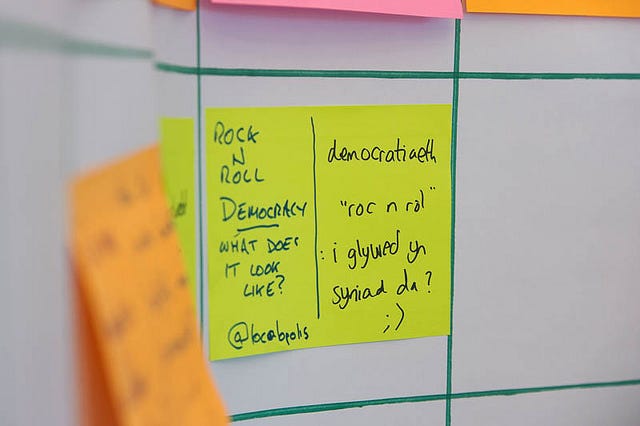
86. Rock and roll local democracy


Imagine that overnight a miracle happens.

Local democracy becomes like rock and roll; stripped back; simple; easy to understand; emotional; exciting; and fun.

How would you know? What would you notice in your daily life? In the morning? At work? In the evening?

These are the questions I shared with two sessions at GovCampCymru. Below is my summary of the wonderful answers I got from the GovCampers.

The questions were inspired by the miracle question; a technique used in solution focussed brief therapy. The purpose of the miracle question is to help people to understand their preferred future so that they can begin to start thinking about the small steps that might move them in that direction. After all, if you don’t know where you are going you will end up some place else.

I used this technique, albeit in a very crude way, to get some ideas from the GovCampers, thinking as citizens, about what rock and roll local democracy might look like.

The ‘local democracy should be like rock and roll’ idea comes from Lawrence Pratchett who argued that local democracy is too much like jazz — an obscure hobby for the dedicated few. It come’s from Pratchett’s chapter in the rather excellent book: British Local Government into the 21st Century. Definitely worth a read.

Someone suggested, brilliantly I thought, that local democracy is more like baroque than jazz — not only obscure but never changing and from another time. I really like this metaphor although I'm hoping it doesn't upset any baroque aficionados out there.

The two sessions were also an experiment in user research for democracy design. As I've argued before, democracy and citizens have been a Cinderella in the government design world. This was certainly not the case at GovCampCymru — maybe I was looking through democracy tinted glasses but I would say that it was the main theme of the day.

Anyhow, here is my write up of the two sessions followed by some suggestions for some small steps that might be taken towards making the miracle happen. A big thanks to everyone who took part — with any luck I have done your wonderful ideas justice. I had fun and I hope you did as well. Biggest thanks go to the two Sarahs — @SarahPrag and @WorkTheWind — who took the notes in the two sessions. Kudos guys.

The morning after the miracle

So, you wake up and local democracy is like rock and roll.

You put on your favourite democracy t-shirt. It’s got the logo of your favourite local democracy collective on the front and a list of all ten of the 2015 meetings on the back.

Check your phone and fire up twitter. Several of your friends are buzzing about a couple of meetings taking place later. One is about the homelessness policy for the area. The other is about a budget decision; the local council has money for a cycle path or a library. But not for both.

Facebook next and your friends have already set up a group to campaign for the cycle path. You are not so sure but you mull it over while you shower.

Now you head for the kitchen to get the breakfast ready.

Flick on the radio just in time to catch the ‘citizens update’ just after the weather. Yes, there are two meetings later and they both sound like they are going to be popular. You've done campaigning on the homelessness issue before but they mention on the radio that Councillor Jeremy — a major local celebrity — will be going to the cycle path meeting. You know you can’t go to both. Tough call.

The kids come down and they excited about the cycle path meeting. They heard about it at school the day before in the daily ‘junior citizens’ session. It used to be just one lesson a year on ‘how the council works’ but now it is every week, and they get to talk about the issues being discussed by the council. They like it much better. After a while the argument gets a bit overheated — as ever the oldest and youngest can never agree -one wants the cycle path, the other says the library is more important.

Outside the school you talk to some of the other parents about the meetings. Two of them run the facebook group for your street and they are pretty up on the issues through the debates that have
already taken place online.

The work day

You've got the kids to school and finally arrive at your desk. The roadside posters and billboards advertising today’s meetings had kept them in the front of your mind while you were driving.
Straight away you see emails about the two meetings from co-workers and a feature on the staff intranet about the same thing. All the usual comments and questions have been added to the intranet story. It’s just what people do while they are having their first cup of coffee and getting their minds in gear.

Next you watch the 2 minute videos on youtube promoting the two meetings— over 10,000 views for each — wow — these are hot topics!

People are talking about the issues by their desks. Your manager comes over and asks you if you are going along later. Tickets are going fast on Eventbrite for both so you might need to get your skates on she says. Meetings like this are usually popular with people queuing round the block to get in.
OK, this is the nudge you need so you get some of the last tickets for the cycle path meeting and dive into your work tasks.

As with most offices, the work day finishes at 3.00 to give people proper time to get involved in democracy meetings. Of course more people had to be employed to get the work done in shorter hours so it worked out pretty well when that change came in.

Of course democracy is not everyone’s cup of tea — it’s a bit too energetic and edgy for some — but it’s easy to tune it all out if you want to. It’s your choice.

The evening

You and the kids get to the cycle path meeting in plenty of time.

They don’t hold these meetings in the townhall any more. It’s in a community centre that has a café bar — you get a yourself a well earned beer and lemonades for the kids.

The whole thing has been organised by the local collective and crowdfunded online. You didn't get involved in arranging this one but you have volunteered for many others. It’s been much better since all these smaller local groups and parties have started to happen. Things feel so much more relevant than when everything was organised through the old style national parties. All grassroots and DIY. Maybe more punk than rock and roll.

The main hall is packed and you find your seats and realise that, wow, you are sat next to Councillor Jeremy. Yes he has had his fair share of scandals (just check out the local papers over the last twelve months!) but you like the way he makes his points and he is your generation and you do feel you have a lot in common. A leather jacket and bright red mohawk hairstyle isn't everyone’s cup of tea but there you go.

Of course these days you can speak to any councillor, not just the one who was elected for your area. A whole range of people are councillors. Men and women of different ages, backgrounds and culture — you just pick the one you identify with most and talk to them. You picked Councillor Jeremy.

Before the meeting starts Councillor Jeremy listens carefully to you and the kids and makes notes on his tablet. He knows that he will be explaining the decision to everyone later so he is taking his time to make sure he understands what everyone thinks. It’s not long though before he’s talking to the others who have spotted him as well as signing autographs. Everyone recognises him of course and everyone feels like they know him.

Soon the debate is underway and people are making their points. There’s also plenty of questions and comments coming in via social media from those outside the hall. People are excited, the room is noisy but it’s all good natured as ever — it’s great to feel part of something. You feel proud to be involved.

Yes, local democracy is like rock and roll and you know what the best part is?

We are the band!

10 Small Steps

The purpose of the miracle question is not just to help people articulate their preferred future but to help identify small steps towards making it happen.

In the same vein, this story that came out of the two sessions, and the wonderful imagination of the GovCampers, suggests a few small steps towards rock and roll local democracy. I've listed them below (they also link pretty well to the #Notwestminster Local Democracy Design Challenges).

  1. Merchandise — t-shirts and mugs for your local democratic process. Why not? If you are proud of it let people know
  2. Advertise the issues to be discussed that day using radio, TV and social media
  3. Make and share short videos to get people interested in the issues (also check out this)
  4. Junior citizens sessions in schools that discuss live council issues
  5. Feed council topics through established local facebook groups
  6. Advertise democracy events on posters and billboards
  7. Use internal comms in councils and other organisations to encourage staff to take part in the local democratic process
  8. Hold meetings to discuss single topics of public interest held in friendly venues and ticketed through eventbrite (definitely not like council meetings). Or, even better…
  9. Support and encourage local groups to hold meetings on issues that the council is deciding on — help people to crowdsource and crowdfund these events
  10. Encourage people to get in touch with the councillors they identify with most when they have any issues — not just their local representative

Thank you GovCampCymru — hope to see you next year.

Originally posted on Medium

Photo Credit: W N Bishop 

Monday, 14 September 2015

84. The Local Democracy Publication Stream


Inspired by the recent Local Democracy Maker Day and LocalGovCamp, the suggestion here is that all council ‘democracy’ publications should be provided in a single stream (rather than by individual committee) on the Council website.  Each publication would be tagged and described by a short summary (snippet).  These snippets would provide a source of open data that could be used to build third party websites and apps to connect citizens with the local decision making process.

As Carl Whistlecraft says the Local Democracy Maker Day was something that seemed unlikely even 12 months ago.  Even though I wasn't there it got me thinking - the long distance power of the GovCamp!

It was particularly good to see the interest in one of our Local Democracy Design Challenges; making local democracy more digestible.  In particular people are asking to see local democracy publications being made more accessible via short summaries – or ‘snippets’.   These are issues we started discussing at the notwestminster event last year.

Following that Notwestminster event we have been using short summaries for all of our scrutiny reports, letters and agenda packs here at Swansea Council. These are all published via our scrutiny publications page.  We put the summaries at the top of all of our documents and in the web page that we publish them in.  Each webpage is also tagged so that the single stream list of all of our scrutiny publications can be filtered by the user.

Here are some examples of short summaries from Swansea’s Scrutiny work:
This is an agenda pack for a meeting for the Schools Performance Scrutiny Panel taking place on the 21 September 2015. The main item being discussed relates to the School Improvement Service. 
This is a letter from the Child and Family Services Scrutiny Performance Panel to The Cabinet Member for Services for Children and Young People following the meeting of the Panel on the 10 August 2015. It is about the Child and Family Services performance report. 
This is the report by the Social Care at Home Scrutiny Inquiry panel about support for older people to remain in their own homes. It contains conclusions and recommendations.
I've written about the scrutiny publications page and how it was developed here.

What if all council publications linked to the democratic process were published like this, in a single stream with all the documents tagged and each with a short summary?

Not only would it be easier for people to find things but it would provide a stream of open data that could be used for third party sites and apps.

I like the idea of a democracy dashboard, suggested at the LD Maker Day, to help people navigate the democracy data.

I'm also imagining an Amazon style ‘democracy recommendations for you’ app…

Or a facebook style democracy timeline made of things recommended by friends and councillors..

Or a ‘Medium style’ ‘top democracy stories’ reflecting my chosen tags.

It’s not quite the democracy bytes idea that we've outlined before (I still think that’s the ideal).  But it would be a great step in that direction.

Anyone want to build it?

Photo: https://flic.kr/p/q9h3YZ

Friday, 17 May 2013

55. Democracy Bytes


Just as a byte is a unit of digital information so a democracy byte is a unit of digital democracy.

If we want to make traditional representative democracy more open, engaging and vibrant by digitising it (and we do) then we need to be clear, conceptually speaking, about what the stuff of democracy actually is. Democracy bytes are that stuff – democracy, broken down into its constituent atoms, so that it can be digitised and shared.

The argument here, which is about how we use digital to enhance local democracy, comes in four parts:
  • We should be talking about the local decision making process rather than meetings, organisations or even elected representatives although they are all relevant and important of course.
  • The local decision making process can be broken down into many separate democratic conversations that lead to decisions.
  • Democratic conversations can themselves be broken down into four basic and distinct types of democratic statement; questions, opinions, proposals and decisions.
  • Democratic statements can be digitised and shared with citizens as democracy bytes.
This post is a development of the ideas I’ve previously shared on Social Council Decision Making and is an aspect of the wider Digital Democracy Framework developed with Carl Whistlecraft. Carl and myself are part of the Localgov Digital Steering Group, where we are majoring on ‘redesigning local democracy in digital world’ and this is a part of our contribution to that work.


Democratic Conversations

If we want the public to be engaged in the local decision making process then we need to offer people simple routes into the decision making conversations that interest them. One big problem with the process at the moment is that local politics is, without an investment of time and effort, a mystery to most people. Lawrence Pratchett uses the metaphor of jazz to argue this point:   
The argument here is that the institutions of local politics have become like jazz: without a high level of concentration they are incomprehensible to most people.... This is not an argument that says that most people are stupid and that politics needs to be ‘dumbed down’. Rather, it is an argument that most people are too busy doing other things to worry about the institutions of local politics: they do not want to work that hard to understand something that is often deemed peripheral to their lives (1).
As Pratchett notes, Jazz was effectively superseded by rock and roll, a form of music that ’stripped back this sophistication to a much simpler sound that was easier to follow and understand’. Not that Pratchett is arguing for simplification at the expense of the necessary subtleties of a political system but rather that the answer might lie with intermediary bodies such as the media or voluntary groups who might act as interpreters.

Democratic Statements

To define a democratic conversation we have to break it down into its constituent parts. In short we can say that a democratic conversation starts with a question, ends with a decision and includes opinions and proposals. Questions, decisions, opinions and proposals are all basic types of democratic statement where:  
  • Questions are the start point of conversations. They are a statement of a problem and an invitation to an audience to participate (they may not always have a question mark). They can originate from anywhere but must be adopted by a decision making individual or group. Examples would include scrutiny topics, consultations or planning applications.
  • Opinions are statements that set out the view of a particular person or body in respect of a question. They will normally be supported by evidence or at least clearly stated reasons. Opinions belong to a named individual or group (e.g. Citizen, Cabinet Member, Council, Scrutiny Committee). They can be presented anonymously as part of a conversation but somewhere it must be known that they are owned by someone entitled to present them. ‘Facts’ enter the process as opinions, partly as every ‘fact’ has some element of subjectivity but more because the relative importance of a ‘fact’ for a question certainly is down to opinion.
  • Proposals are statements that make a recommendation about what an individual or group, responsible for a decision should do. They are directed to the specific individual or group who has the power to make the decision. Proposals are promoted by questions in as far as closed questions limit the range of possible proposals down to a minimum of two whereas open questions are less prescriptive.
  • Decisions define the ends of conversations. They are statements about what the council will do and relate to policies and services for which the council has responsibility. Decisions will be taken only by the individual or body that has the legal responsibility for that decision – the decision maker.
This is of course pretty much how it works already just stated in a more generic way. The intention is to define a language that applies whether we are talking about cabinet, planning, scrutiny or any other council function. Cabinet ‘conversations’, for example, operate within a clearly defined policy framework. Questions, often triggered by officers, lead to consultation processes that gather opinions and proposals before decisions are finally taken. Scrutiny inquiries follow the format of questions, evidence gathering, conclusions and recommendations. For planning process, applications are questions, objections are opinions, proposed amendments are proposals and decisions are, well, decisions.
The idea is that, by using a common language across all of these processes, we can generate one single flow of democratic conversations before providing them to citizens in a bespoke way; we can move from an approach that is committee centred to one that is citizen centred.


Democracy Bytes

Democratic statements linked in democratic conversations and made available digitally in a form that people can share and comment on, become democracy bytes. In one sense we can say that these are ‘digital minutes’; they are the open data of local democracy (the word minute actually means ‘chopped small’, which is exactly what we need the decision making process to be if we are going to make digestable it to the public).
How democracy bytes are shared is a matter for local debate – it could be a single site or a range of apps. Great examples already exist of course. Check out Ask Bristol or the Friction Free Democracy project for example.
By clarifying what democracy bytes are we can at least have a common understanding of what the stuff of local democracy actually is and a clear assignment for developers to work with. The challenge for local councils is to find the technical ways in which these democracy bytes can be shared. The day to say sharing of a democracy bytes will be, in the first instance, a role for democratic support staff. No, actually this will be an entirely new role for democratic support staff but that sounds like another post.

Update:  A suggestion from @gr8governance that there is a fifth type of democratic statement - Outcomes - makes perfect sense to me.  Outcomes describe the consequences of conversations that follow (or not) after the decision has been taken.  In the scrutiny world we might call these 'follow ups'.  Similarly decision trackers are concerned with outcomes and 'delivery' is a word that gets used in this context.  Care needs to be taken of course with the word outcome as it has a range of different meanings - here it means the immediate impact of a decision on the service or organisation to which the decision relates.  The wider social, economic and environmenatl effects are another story for another day!    

(1) Pratchett, L (2004) Making Politics Work in Stoker and Wilson (Eds) British Local Government into the 21st Century, Palgrave Macmillan

Sunday, 21 October 2012

50. Civic Solutions for Wicked Problems

The concept of wicked problems is both important and tricky.  Important because it refers to those intractable social and economic issues that most policy makers and practitioners are grappling with; issues like youth unemployment, childhood obesity or substance misuse.  Tricky because the concept of wicked problems is itself ‘wicked’ and subject to differences in definition and interpretation.

This post sets out some thoughts about wicked problems and how they might lead to particular types of responses that I'm calling civic solutions.

Matching Problems and Solutions


A few weeks ago Megan Mathias from Kafka Brigade UK gave a presentation to our community planning conference on ‘Solving the Wicked Problems’.  The purpose was to help inform the thinking for our city’s new Single Integrated Plan (that’s Welsh version of the community strategy). It was this presentation that got me thinking (always a good sign!). 

Megan’s central point, I think, was that we need to be clear about what type of problems we are seeking to solve as this will inform in a major way our responses to those problems.   Megan drew in particular on Keith Grint’s typology of problems and responses (see Keith Grint’s presentation here). 
Grint argues that:
  • For ‘critical’ problems such as a major police incident, for example, we need a command response – one that is immediate, top down and decisive
  • Tame problems such as conducting heart surgery, launching a new product or relocating a business are complex but can be addressed ‘scientifically’ and hence can be solved through  a management response
  • Wicked problems, such as knife crime, for example, cannot be solved through ‘management’.  In fact they may not be completed solved at all, rather they may only be mitigated.  The response required here is one of political collaboration – in other words leadership.

Wicked Problems


Grint offers the following characteristics of wicked problems:
  • Either novel or recalcitrant
  • Complex rather than complicated (cannot be solved in isolation)
  • Sit outside single hierarchy and across systems – ‘solution’ creates another problem
  • They often have no stopping rule – thus no definition of success
  • May be intransigent problems that we have to learn to live with
  • Symptoms of deep divisions – contradictory certitudes
  • Have no right or wrong solutions but better or worse developments
  • Securing the ‘right’ answer is not as important as securing collective consent.
  • Feasibility not optimality; coping rather than solving
  • Uncertainty & Ambiguity inevitable – cannot be deleted through correct analysis
If you are unfamiliar with the idea of wicked problems then the Wikipedia page (should that be wickedapedia *ahem*) is a good a place to start as any.  Definitions tend to vary but they usually come in lists of characteristics - see this paper by Head and Alford (pdf) for more on this. 

For me wicked problems are best understood as symptoms of wider social and economic structures.  There is perhaps a danger that wicked problems might be thought of almost as having an existence independent from the ‘real’ world- like malevolent ghosts that have arrived from some mysterious other world. 

It is important to remember that wicked problems are of course symptoms of deeper social and economic problems.  To use a medical metaphor; they are like chronic conditions, some of which can be managed to the point that the individual leads an almost completely normal life as long as they can maintain the management regime required.  Other chronic conditions cannot be managed as easily and the individual has to accept that the symptoms will continue to be challenging.
 
There is also something a little fatalistic in saying ‘wicked problems’ can never be completely solved.  I’d rather say, like a doctor might, that these are conditions that can be managed until the cure is found.  Take the example of child labour in 19th century Britain for example.  At the start of that century it must have looked like an intractable wicked problem.  Clearly it is no longer seen that way.  Not in the UK in any case. 

It is also important to understand wicked problems as issues that affect us all to a greater or lesser extent;  whether directly as ‘victims’ or indirectly through the impact on the wider economy for example. 

In the same way I would argue that everyone shares responsibility for wicked problems.  I mean this both in the sense that we are all responsible for these issues in the first place to some extent, whether by action or inaction, but also that we are all responsible for the solution.  Grint puts it well in this report on Total Place (pdf) when he says that a wicked problem:
...requires a long term collaborative engagement by the whole community. The trick here, then, is to ask the right question. Not, ‘how do we stop knife crime?’ but how do we get the community more involved in self-policing?

Civic Solutions


Which brings me onto to this idea of civic solutions by which I mean:  Emergent strategies to tackle wicked problems that involve the whole community including public services and the voluntary and business sectors.

This is an approach that contrasts with traditional top down approaches.  As Helen Sullivan argues:
An alternative model, talked about a great deal in the literature, but rarely applied, looks at ‘whole of government’ from the bottom rather than the top, emphasizing the merit of taking decisions and being responsible for them as close to service users and citizens as possible, and of connecting to others through flexible networks rather than reconstituted hierarchies. This poses a fundamental challenge to strategic thinkers who can conceive of strategy only in top-down, centrally determined ways, as it requires thinking about strategy as emergent, generated by interactions between the different actors involved wherever they are in the system.
That’s the general idea – the next step is to map out what these civic solutions might look like in practice and, more specifically, what they might mean for whole place partnerships and their single integrated plans.

Thursday, 28 June 2012

45. Community Participation: Five Tips from Rousseau

Today is the 300th anniversary of the birth of Jean Jacques Rousseau. To celebrate this most auspicious of days, here is my take on what Rousseau might say to anyone involved in community participation today. 

Rousseau is my favourite political philosopher and The Social Contract (250 years old this year) is my favourite political book. If you are interested you can read The Social Contract online here or enjoy a couple of Harvard lectures about Rousseau's discourse here and The Social Contract here.

Obviously I can’t do justice here to the work of the great man in a short post – I’m sure I wouldn’t be able to even given the time and space – but here is, I think, in a nutshell, the core of his political argument:

The Social Contract

Rousseau’s central contention is that, in the modern world, people can only enjoy freedom thought direct participation in politics. Furthermore, we are free only when we obey those laws that we have made ourselves. For Rousseau, the moment you let someone else decide the laws you live under, whether it be a monarch, dictator or elected representative, you become no better than a slave.

How then can you only obey your own laws and yet live in a community with others? The Social Contract presents Rousseau’s solution to the problem. It represents a voluntary political association where everyone participates in the making of laws for the community interest (also known as the general will). The key bit is that the laws apply generally, so that everyone is equally affected:
‘...as every individual gives himself absolutely, the conditions are the same for all, it is no one’s interest to make conditions onerous for others’
Clearly, as Rousseau would also accept, the social contract is an ideal state which is unlikely to ever be seen in reality. However, it provides, I think, a fine political aspiration.

Community Participation: Five Tips from Rousseau

So, what might Rousseau say about modern community participation? Here are five lessons that I think can be drawn from the Social Contract.

1. Get everyone in the community to sign up

The social contract only works because everyone has signed up to it, it cannot be imposed. Similarly community participation needs the consent of the whole community (or an overwhelming proportion of it), whatever that community might be. It might be raised hands at a meeting or a signature on a form; what’s important is that voluntary act of association. If this cannot be achieved then maybe the community participation approach needs to be changed, or maybe community participation isn’t appropriate at all.  

2. Only consider general principles

One thing Rousseau would definitely say is that community participation should only be concerned with general issues for the community, issues that affect everyone, if not exactly the same, then in a similar way. Particular issues, such as what happens in one street, or a planning application, will draw out particular interests and lead to conflict. Instead, general issues, such as the speed limit, the acceptable noise level or even the overall balance of spending in an area should be the focus. It is for the ‘government’, whether it be the local authority or another public body to interpret the general principles and put them into practice in particular cases. Once again, if the community as a group gets involved, it can only bring conflict.

3. Only ask about what’s best for the community

Like Rousseau’s general will, the community will expresses the interest of the community as a whole. The question to be asked is not ‘what is best for you?’ or 'what do you want?’ but ‘what is in the best interests of the whole community?’ For the community will is not the ‘average’ of all individual interests but the result of a careful consideration of what is best for all. The fact that everyone is affected more or less the same is important in this context.

4. Ask people to consider the issues as individuals

For Rousseau the general will has the best chance to emerge when citizens undertake their own careful consideration and are not bound by party allegiance or swayed by those with vested interests. So with the community will it is important that party politics, pressure groups or any other type of faction are kept at bay. Citizens should be provided with information and encouraged to debate but not to campaign.

5. Get everyone to participate

For the community will to emerge everyone, or nearly everyone, in the community need to be involved. Comprehensive participation also increases the likelihood that everyone will feel happy to be bound by community laws. Rousseau’s Social Contract was concerned with small city states where face to face participation was possible. There is no reason why communities could not be defined as small enough to make this happen. Alternatively, the use of social media and web technology could make the involvement of larger groups possible.


For me, Rousseau’s political philosophy can be used to underpin a distinctive approach to community participation, an approach that might be challenging in practice but a worthwhile aspiration nevertheless.


Picture credit (portrait): http://en.wikipedia.org/wiki/File:Jean-Jacques_Rousseau_(painted_portrait).jpg

Tuesday, 19 June 2012

44. Local Digital Democracy: A Five Point Checklist

Back in February 2011 I wrote a joint post with the legendary Carl Whistlecraft setting out some thinking on local digital democracy and what it might look like.  You can find the original post on Carl's blog here.

In the post we defined local digital democracy as:
  • Using social media to make a bridge between the formal world of local politics and the real world of real people
  • Being clear that local government is not just about services – it has a distinct and important democratic role with elected local councillors at its heart
  • Recognising that the world is changing.  Social media is changing the way the world works – local democracy needs to catch up
  • Recognising that local democracy needs stronger citizen engagement
  • Building from the traditional ways of doing things and using online tools to make them work better and reach more people
We could also see numerous benefits including for decision making and for reputation, for councillors, officers and citizens.  

In the post we identified the five essential features of local digital democracy.  Here I have just tweaked them into a into a checklist of five questions.  I think they provide a nifty little framework for assessing whether any given council 'has' local digital democracy.  How does yours score?

Local Digital Democracy:  A Five Point Checklist for Local Government


1.  Are Councillors Online?   
  • How many councillors are blogging, tweeting, facebooking etc?
  • Is training and support provided for those using social media?
  • Are awareness sessions provided for those who haven't yet put their toes in the water?
See CllrSocmed for much more info on this.

2.  Is the Council's Online Decision Making Social? 
  • Can online agendas, minutes and reports be easily shared via social media?
  • Are items broken down into bite sized chunks rather than published in unwieldy PDFs?
  • Is it possible for people to comment on decision making items via social media?
See my previous post on social council decision making here. 
 
3.  Are Council Meetings Social?
  • Do meetings have webcasts that allow engagement via social media?
  • Can councillors and citizens tweet at Council meetings?
  • Does an officer provide a formal live commentary on meetings via social media?
See the Kirklees experience for a great example.
Dave Briggs has also been looking at the issue of tweeting at council meetings.

4.  Are Local Elections Social?
  • Do election teams make use of social media to promote the election process?
  • Do candidates share their election materials online or parties provide online manifestos?
  • Are results shared via social media?
Again, more wonderful stuff from Kirklees.

5.  Is There a Local Digital Democracy Community?
  • Is the Council proactively supporting local digital democracy?
  • Are initiatives such as Local Democracy Week being used to support digital engagement?
  • Are there online communities supporting local digital democracy and looking at how it might be improved?
I've posted before on Council's producing democracy plans - what's needed is a digital version.

So, what does your Council score out of five?  I'd be amazed if any actually scored five but, who knows, maybe one day...

Photo credit: http://www.flickr.com/photos/usnationalarchives/3660047829/

Wednesday, 6 June 2012

42. Cause Marketing for the Public Sector

I saw this blog post from Richard Layman (via @greatemancipato) about some of the issues around parking provision in cities.  The whole thing is worth a read but what particularly caught my eye was the proposal by Professor Donald Shoup, working for the city of Pasadena, that the higher parking charges he had suggested could be made more palatable to local businesses if they could see that the money was going back into the city centre:
To address the concerns of the proprietors of businesses in the commercial district, who preferred low-priced parking because they believed it to be key to the success of their businesses, he recommended to the city that they spend the bulk of the revenue generated by the parking meters on public space and other improvements to the commercial district.
It turned out that this approach worked as a parking scheme and was also acceptable to local business.

For me, the moral of this story is that when people pay charges or taxes they feel much better about it if they know where the money is going and agree with what it is being used for.  OK, I don't have any hard evidence to back this up (a topic for further research perhaps?) but I know from my days working in the Housing Department how passionate council tenants were that the money they paid in rent was used only to benefit council housing (the law agreed as it happens).  I'd also suggest that this connection between donation and use is an important motivation in charitable giving.  Conversely I know that many people don't like the idea of their money going to 'the council' who they believe wants their money simply to grow rich.

Turns out that the parking story is an example of 'cause marketing'; something that is already a thing in the private sector. Take this example from the wikipedia page:
Following various pilot schemes in 1981, American Express developed a campaign which donated funds to a number of different non-profit organizations as part of the San Francisco Arts Festival. Essentially every time someone used an American Express Card in the area, a 2 cent donation was triggered and each time new members applied for a card a larger contribution was made... Card usage was reported as having increased significantly and relationships between American Express and their merchants also improved as a result of the promotion. From the charity's point of view, despite being a short-term campaign, $108,000 was raised, making a significant contribution to their work.
The idea of cause marketing seems like a useful one for local government, particularly the idea of stating where charges will go.  Even it it is something that already happens it would make sense to make it more visible and advertise the fact. It doesn't even need to be the whole amount or a permanent thing e.g. "this month 50% of car park charges are going to support the local park".  Other obvious areas where this might apply include leisure centres, theatres, museums and galleries.  I'm sure there must be others.
I wonder if it might even apply to to council tax.  Of course it isn't voluntary and council's often do provide a nice pie chart showing where everything goes, but maybe more could be done to give people a genuine sense of connection between the local tax they pay and the benefits that it provides.  Maybe each year there could be a theme i.e. 5% of council tax could be allocated to healthy city initiatives or maybe to school literacy schemes.

Either way, strengthening the link in the minds of citizens between charges and taxes on the one hand, and public good on the other, can only be for the best.

Photo credit: http://www.flickr.com/photos/davedugdale/5457170804/


Friday, 24 February 2012

34. Evaluate the Policy Outcomes from Public Participation

If I want to describe the force of an earthquake I can use the Richter scale, if I want to describe wind speed I can use the Beaufort scale but if I want to describe the impact of public participation on local government policy and decision making (and I do – it’s what my PhD is about) what can I use?

The answer is nothing as far as I know. 

The purpose of this post, therefore, is to share the crude scale I’m using to describe the value of the outcomes from participatory initiatives on policy and decision making.  It is very much a work in progress so please feel free to suggest improvements!

My Kind of Outcomes

Public participation initiatives, such as citizens’ panels, area forums, focus groups etc, will normally consider issues, relevant to policies or decisions being considered and will produce outcomes.  By outcomes I mean opinions or proposals that might be captured formally through minutes or reports, or informally by decision makers, perhaps councillors, being present and taking conclusions away with them.  These outcomes are the policy products of participatory initiatives.    

Evaluating Public Participation Isn’t Simple

While I am only really interested in those outcomes relevant to policy and decision making there are of course a wide range of other outcomes that can be evaluated, sometimes it seems, to the exclusion of the ones I’m interested in.   

I’m not going to get into the whole thing here.  If you want to see the whole picture then Tina Nabatchi has produced a very useful ‘Manager’s Guide to Evaluating Citizen Participation’ that you can download here.  It gives a very good feel for the challenge of evaluating public participation, as she says:

Public participation is an inherently complex and value-laden concept. There are no widely held criteria for judging the success and failure of citizen participation efforts. Some advocates focus on the intrinsic benefits of participation and believe that its instrumental outcomes are irrelevant. Others focus on its instrumental outcomes for citizens, communities, policy, and governance. Critics often doubt both sets of claims.

Nabatchi’s guide also highlights some of the specific challenges associated with evaluating the specific type of outcomes I’m interested in:

...there are difficulties in demonstrating causal links between participation and policy outcomes, in part due to the time lag between processes and policy or public action, as well as intervening events. There is also considerable ambiguity about what would constitute a substantial impact, which means that impact must be considered in relation to the initial goals of the participatory program. Finally, scholars and practitioners are still devising methods with which to better examine the links between public participation processes and public policy changes and action.

This then, is my attempt to try and address those challenges.

A Simple Evaluation Scale

For my scale I have borrowed from this paper by Paul Burton on measuring the benefits of public participation.  In particular two of the ‘strands’ he argues need to be considered when conceptualising participation.   

The first strand is the level or scope of the decision:  Burton describes the possible range like this:

At one end of the continuum are decisions that affect everyone in a particular constituency or jurisdiction, while at the other end are those affecting only a few.


I’ve adapted this a little bit and have divided decisions between those that are strategic, affecting the whole local authority area, and those that are local, affecting one community or population group.

The second strand is what Burton calls the participatory relationship, in other words:

the relationship between those people who choose to or are invited to participate and those who retain formal responsibility for making the decision in question. At one end of the spectrum formal responsibility for taking a decision is handed to all participants, for example in a referendum, while at the other end participants are allowed only the most cursory degree of involvement and in ways that have no meaningful impact on the decision taken. 

Again, to simplify, and to place this in a local government context, I’ve distinguished between those cases where the difference made is decisive and where the initiative has been informing. 

From a councillor perspective these two categories are the flip side of two classic representations of the councillor role.  For those councillors who see themselves as trustees, in other words, elected to follow their own judgements, the informing relationship is likely to fit more comfortably.  For those that sees their role as one of delegate, closely representing the views of the public, a more decisive influence might be more likely.

Putting the two strands together generates four types of value and looks like this:

I then translate this into a four part scale as follows:

1.  High Value (Strategically decisive)
Outcomes either substantially change the intended decision / policy or bring a clear direction where the way forward was in doubt.  We would expect this to happen in connection with council, cabinet or even strategic partnership meetings.

2.  Medium Value (Locally decisive; strategically informing)
A substantial change or a clear direction is affected at a local level through say an area committee. 
Alternatively the influence is council wide and the outcome has been clearly taken into account but as one of many considerations of which others were decisive.  

3.  Low Value (Locally informing)
The outcome has been clearly taken into account by local councillors or officers acting locally but it cannot be said to be decisive.

4.  No Value (Neither decisive nor informing)
Nothing has happened as a consequence of the outcome.

I appreciate that this scale is a crude one that plays fast and loose with many subtleties and is likely to be highly subjective in its application.  No doubt it could also be improved. Nevertheless I believe it at least goes someway to describing something which has (probably) never been properly described before. 

Photo credit: http://www.flickr.com/photos/playingwithpsp/2280744328/

Thursday, 13 October 2011

25. Everyone Can Vote

This is guest post from Dr Toby James from the Department of Political and Cultural Studies, Swansea University:


Idea 18 suggested that making voting compulsory couldimprove local democracy.  Turnout is low in local elections in most democracies, commonly flat lining in the 30-40% range.  Fining people who don’t vote would be one fix.
 
One reason that people may not vote, however, is that they lack the time.  We have many competing demands on us.  Sometimes we don't have a babysitter, we work long shifts, need to get to a friend's party etc.  Citizens can easily be distracted from participating in our democratic institutions.  It is not that they necessarily do not wish to be involved in local democracy or do not want their views to be heard. 

In some countries voting and registering to vote can be very bureaucratic and time consuming. Citizens often have to visit a polling station to cast their vote, which may involve considerable travel.  They may be required to present special forms of photographic identification to vote.  Sometimes citizens may find that they need to register to vote a long time in advance of an election and provide intricate personal information such as social security numbers to be included. 

The more intricate and bureaucratic the requirements imposed on voters, the more likely that some will slip up and not make it onto the register.  In the UK, citizens wanting to cast their vote by the post have had to provide a date of birth and signature on their application form for a postal vote and their eventual ballot paper.  The two are then compared.  But some votes are often deemed invalid because citizens make administrative errors like providing the current day as their day of birth. Asking citizens to provide a social security number is even more burdensome.  Do you know yours off the top of your head?  One election administrator recently gave me the example of a citizen who wanted to vote, but who she could not add to the electoral roll: 

‘We had one woman every year would give you her national insurance number. Every year you’d write to her and say “That’s not your national insurance number.” It turned out it was her gas mask number from the war but she was convinced that was her national insurance number and there’s no way you could get any other number out of her.’

The procedures for voting and registering to vote are not always so out of tune with modern lifestyles.  In some elections voting and registering to vote is very convenient.  Some states in the US allow citizens to turn up and register on the day of election.  In Estonia and Norway citizens could cast their vote over the internet.  The UK has experimented with all postal elections and these provided an enormous boost to voter turnout.  In the US you can register to vote when you apply for your driving license.  Making the polling station closer to the voter increases the chances that they will vote.  Extending election day over two days, or even a week, helps too.

We are increasingly a Facebook/Twitter/XFactor generation.  We are used to everything being a click away.  Why should we have to travel to the village hall to let government know our views?

For an overview of the research on how election administration can increase turnout, and a broad brush tool for practitioners to identify some reforms, see my article in Representation (which is free to download).

Wednesday, 21 September 2011

22. The Co-productive Council

I’ve been doing some work with the excellent Prof. Tony Bovaird lately on co-production and it prompted me to think about what a co-productive council might look like.   First, however, a few words about co-production as, if you didn't know, you might have thought it was all about making movies...

 Co-production in Public Services

Co-production is an idea that is certainly gaining traction. There are probably too many definitions but a good place to start is where the phrase was first used:
The term ‘co-production’ was coined originally at the University of Indiana in the 1970s when Professor Elinor Ostrom was asked to explain to the Chicago police why the crime rate went up when the police came off the beat and into patrol cars. She used the term as a way of explaining why the police need the community as much as the community need the police.(new economics foundation, 2008: Co-production: A Manifesto for growing the core economy)

The New Economics Foundation and NESTA describe it this way:

Co-production is a new vision for public services which offers a better way to respond to the challenges we face - based on recognising the resources that citizens already have, and delivering services with rather than for service users, their families and their neighbours. Early evidence suggests that this is an effective way to deliver better outcomes, often for less money.


A great summary can be found here.  This overview by Tony Bovaird, Elke Löffler and Frankie Hine-Hughes, highlights how the concept can be broken down to apply to different aspects of the service delivery cycle such as co-planning, co managing or co-assessment.

For a really interesting example of a whole Council approach take a look at Lambeth Council.  They have recently defined themselves as a 'Cooperative Council and are seeking to underpin all of their service delivery with the principles of co-production.   A white paper was produced and a special commission set up to work through the proposals before the approach was agreed - there is plenty of material to look at.

Can Local Democracy Be Co-produced?

In many ways this sounds like restating the question about whether representative and participatory democracy can work in tandem or even be combined.  In some ways it is but in some ways, however, applying the debates around the co-production of services to the co-production of policies and decisions opens up a new perspective on some old problems.  Start thinking about politicians instead of professionals, citizens rather than service users and policy cycles rather than service cycles and I think there definitely something new to be had.

Borrowing from Bovaird et al, the benefits of co-producing democracy can be stated as follows:
  • citizens know things that many politicians don’t know
  • ... and can make a policy more effective by the extent to which they go along with its requirements
  • ... and have time, information and financial resources that they are willing to invest to improve their own quality of life and into helping others
  • … and have diverse capabilities and talents which they can share with politicians and other citizens
  • … and can engage in collaborative rather than paternalistic relationships with politicians, with other citizens and with other members of the public
The Co-productive Council

Adapting the principles of the co-production of services, then, it is possible to imagine a Council that co-produces its democracy.   

Like the ideal of co-producing services, where initiatives can take place at every stage of the service delivery cycle, the co-productive council would have in place co-productive activities at every stage of the policy and decision making cycle.  So, borrowing again from  the model by Bovaird et al, it is possible to conceive of a co-productive policy making process:

Co-defintion of problems – e.g. area forums, community conferences, petitioning

Co-formulation of options – e.g. co-option of public onto scrutiny committees, community / user consultation

Co-decision making – policy juries, referenda, online deliberation

Co-implementation – (see co-production of services!)

Co-evaluation - co-option of public onto scrutiny committees, area forums

This simple framework might be the starting point for identifying gaps and looking at what areas might need to be developed if a council is to be truly co-productive.

One final thought, a co-productive council would also be one where councillors, like the Chicago Police, would get out of their metaphorical patrol cars and onto the metaphorical beat.  Although this is of course what many, if not most, councillors do already.  It seems that the foundations for a co-productive council may already be in place.

Monday, 21 June 2010

11. Facebook Style Democracy

This idea may be the first of many drawn from the world of social media.

Whilst some see social media as an enhancement for local government and democracy for example, others may see it as a more effective alternative, especially for organisations.  It is not difficult to see why given both the level and extent of participation in sites such as facebook compared with involvement in local democracy.  No doubt the rise of social media presents a challenge for democracy at many levels.  The important point for me, however, is that people are crystal clear about what democracy is, and what social media is, and not to blur the distinction between the two.
Another way of looking at things is to see social media platforms such as facebook as useful metaphors for how local democracy might work.  In other words taking the successful structures and patterns of participation of something like facebook and applying them to democratic practice.  Behind this is the belief that social media platforms have much more successfully tapped into natural modes of human interaction and political behaviour than local governments, and therefore hold useful lessons for democratic practice which was perhaps better suited to very different times.

Facebook Style Democracy is my own 'thought experiment'. I'm taking what I believe to be the successful attributes of facebook (feedback, affiliation, networks) and thinking how they might appear in local democratic form.  I'm also trying to imagine it offline as well as online (although online is the most likely form offline forms may be required for inclusion and choice)

Facebook Style Democracy, then, would have the following features.

  • Bespoke individual accounts where people can set their own democratic preferences to receive information and interact with only those issues they chose to (customer management systems in many local councils can already suggest services and benefits to customers based on known intelligence - a democratic version of this would ask for opinions on policies etc in the same way)
  • Preferences and allegiances visible and open (Citizens could display theirs on front doors as well as on their online profiles)
  • Policy development conducted on fan pages with polls, comments and discussions providing opportunities for citizen interaction (this could be a physical location - a policy shop in the town centre, for example)
  • Citizens establish their own policies by setting up fan pages (policy shops) and campaigning for support
  • Decisions made through 'like button' referenda.  In other words local laws would be passed if a given percentage of the population approved (this could also be done physically through more traditional means)
Government in Facebook Style Democracy is made up of a number of different officials:

  • Facilitators: Setting up pages, running referenda, sharing issues, spotting opportunities for bringing different campaigns together, closing pages etc. 
  • Moderators: Ensuring rules are complied with e.g. offensive language, abuse, privacy etc.
  • Capacity Builders: Providing education, training, support for individuals etc.
  • Implementers:  Running services and enforcing local policies
Officials would be elected - again through the use of like buttons.  People would put themselves forward for posts and those most 'liked' would be elected.  Elections would be a continuous process as citizens would have the right to 'unlike' whenever they felt the need.  Hence officials would be assessed by citizens in real time - there would be no need for election campaigns and no real role for political parties either.

Note that elected officials are not representatives - this form of democracy is purely participative - officials have a technical not a democratic function.

The structure and form of Facebook Style Democracy would be dynamic not static.  Citizens could change the way their democracy works.  (Facebook themselves are tentative steps in this direction - see this discussion for example.)

Facebook Style Democracy seems highly suited to our 'postmodern' world.  Perhaps an ideal way to support people swarms and a truly sovereign citizenry.


Update:  Here is another post in a simlar vein flagged up by Carl Haggerty.